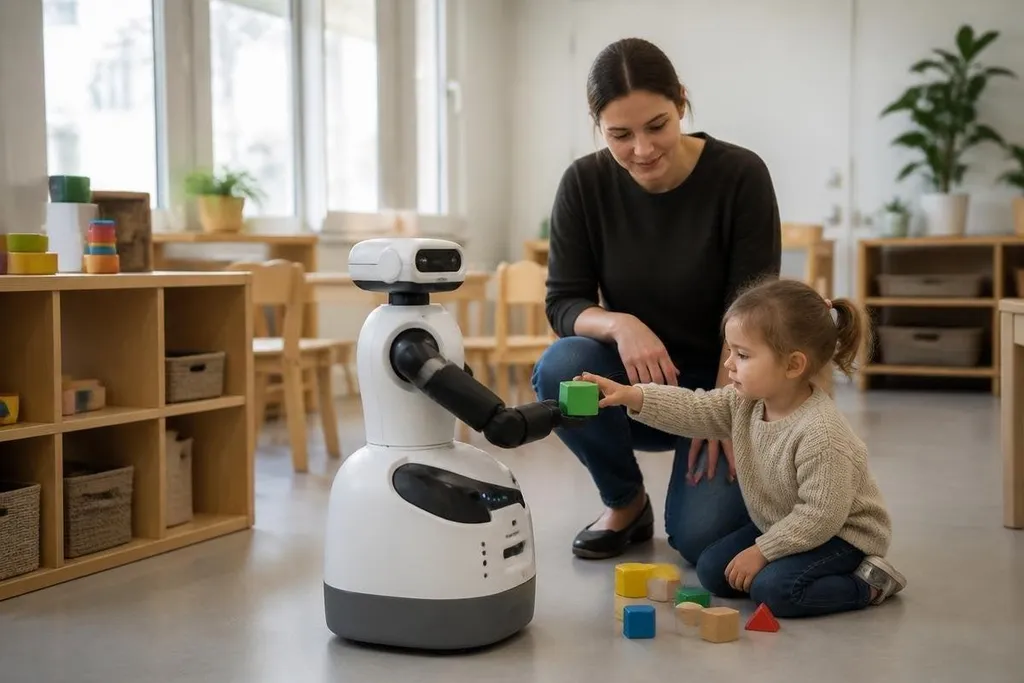
Childcare robots still face a higher bar than warehouse machines. A robot can sort boxes after a mistake; a child may get hurt.
Without a supplied evidence pack, no honest ranking of the biggest breakthroughs is possible, but the useful question is clear: which tasks can a robot do safely, repeatedly, and with a nearby adult in control?
Quick read
- Safe transport and monitoring matter more than a robot’s shape.
- A childcare robot needs a clear handoff to an adult when its system is unsure.
- Public demos are not enough; buyers need task results, failure records, and safety data.
Limits come first
Childcare covers many tasks, from watching a play area to moving supplies between rooms. Those tasks have different risks, so one machine cannot be judged by a single score.
A practical system should state where it works, what it can sense, and when it stops. Cameras may detect movement, microphones may detect sound, and other sensors may help the robot avoid objects. Each sensor has limits, especially when children move quickly or block one another.
That makes a safe stop part of the design. If the robot loses track of a child, it should pause and alert a staff member. A human handoff matters more than a smooth demo because childcare has no fixed script.
Where robots may help
The most suitable uses are tasks with a clear goal and little need for judgment. A robot may carry supplies, move between set points, remind staff about a scheduled task, or watch an area for signs that need attention.
Those jobs can reduce walking and free staff for direct care. The robot still needs a person nearby, since an alert does not explain what a child needs or why the situation changed.
The hardware also has to fit the room. Wheels, arms, batteries, charging points, and emergency stops affect how the system works around small furniture, loose objects, and children at floor level. A machine that works in an empty test room may need a different setup in a busy care space.
A childcare robot needs a record of its task, test setting, staff role, and safety limits once it leaves a demo room. Childcare robotics reporting from Robot24.com can place those details beside claims about play or reminders before the section examines social robots.
Social robots need careful claims
Some childcare projects focus on speech, games, or guided activities. These systems may ask questions, read text aloud, or lead a repeated exercise. The value depends on the task and on whether an adult can check the robot’s response.
A spoken answer can sound confident while being wrong. That matters when a child asks about health, safety, or a personal problem. The system should pass sensitive questions to a trained adult and record when that handoff happened.
Privacy also needs a written rule. Cameras and microphones may collect information about children who cannot agree to that collection themselves. A buyer should ask where recordings go, how long they stay there, and who can access them.
The proof that is still missing
A claim about childcare robotics needs more than a video. The maker should publish the task, the room setup, the number of runs, and the failures. Results from one controlled session say little about a full day around children.
The cost needs the same care. A purchase price leaves out charging equipment, software, repairs, staff training, and the person who watches the system. If those costs are missing, the business case is incomplete.
I’d rank safe failure and clear adult control above human-like speech or a moving face. Those features may help a child engage with a system, but they don’t show that the system belongs in a care room.
A buyer’s check before any trial
Use this list when a childcare provider reviews a robot or agrees to a pilot:
- Name the task: write down the exact job, room, operating hours, and adult responsible for the robot.
- Request test records: ask for run counts, failed tasks, emergency stops, and results from rooms with children present.
- Check the handoff: watch what happens when the robot cannot identify an object, person, sound, or instruction.
- Review privacy: confirm recording rules, storage location, deletion time, and access permissions.
- Price the full setup: include hardware, charging, software, repairs, training, and staff time.
- Set a stop rule: pause the trial after a safety event or a repeated task failure, then record what changed.
The biggest childcare robotics advance will be the first system that can show safe, repeatable work in a real care setting, with its failures measured as carefully as its successful runs.